|
| |
|
Zug, located between Zurich and
Lucerne, is a perfect place for
Hikes and Walks in Central - Switzerland and beyond.
Zug, zwischen Zürich und Luzern gelegen, ist ein
idealer Ort für
Wandern und Spazieren in der Zentralschweiz und in
benachbarten Regionen.
|
|
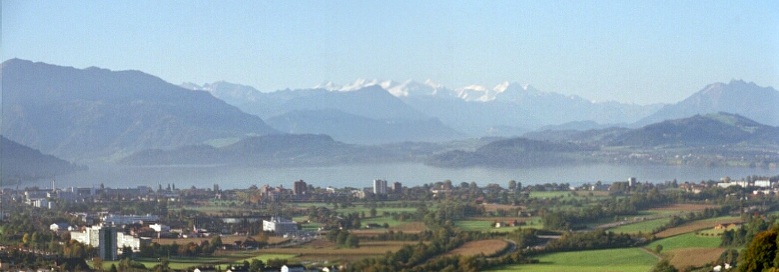
Rigi, Zugersee,
Stanserhorn, Berner Alpen, Pilatus
Download
Panorama
|
|
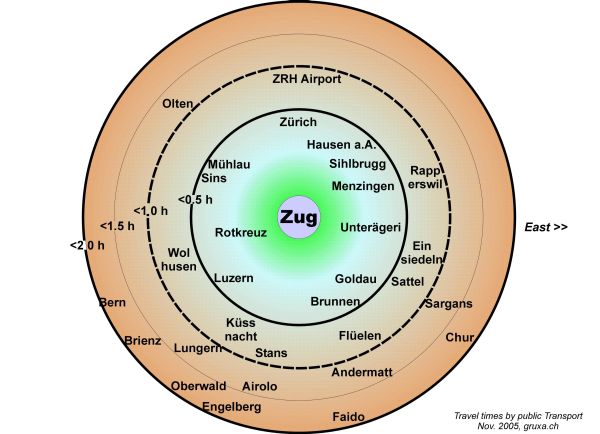
Distanzen ab Zug
in Stunden
mit
öffentlichem
Verkehrsmittel |
 
|
Distances from Zug
in hrs
by
public
Transport
|
Kalender 2010 (Kalender_2010.pdf
16kB)
|
Zentrale
Lage in der Schweiz:
Zug
gehört zur Zentralschweiz, ins Voralpengebiet, vor den
Hochalpen.
Das
Gotthard Massiv teilt Nord- und Südschweiz.
Das exakte geographische Zentrum
der Schweiz ist die Alp Aelggi (660.895/183.251) im Gebiet von
Melchsee Frutt oder 46°
47' 51 n 8° 14' 10 e.
In
der Gegend von Zug fällt noch immer auf, dass gewaltige Gletscher vor
kurzem (10'000 Jahre) die heutige Landschaft geprägt hatten: östlich
floss der Linth Gletscher, westlich näherte sich der Reussgletscher.
Im Gebiet Menzingen stiessen die beiden zusammen.
Landschaftlich bietet das Zugerland von allem etwas: liebliche
Landschaften mit Bächen, Seen, Feldern, Wäldern, Hügeln.
Ein
Schritt weiter und wir befinden uns im Hochgebirge.
Noch ein kurzer
Schritt und wir betreten andere Kulturen: das Tessin im Süden; im Osten
Graubünden; im Westen das Wallis!
|
Centrally
located in Switzerland:
Zug
belongs to
Central Switzerland
, into the „Pre Alps“
(Voralpen), just ahead of the „High Alps“ (Hochalpen).
The „Gotthard
Massive“ divides North and
South Switzerland
.
The exact geographical
midpoint of
Switzerland
is Alp Aelggi
(660.895/183.251) in the Melchsee Frutt area or 46°
47' 51 n 8° 14' 10 e.
In
the Zug area it’s still noticeable that huge glaciers, only shortly (10'000
years) before, have formed today’s landscape: in the East there
was the Linth glacier, from the West the Reuss glacier was approaching. In
the Menzingen area the two merged.
Scenically the “Zugerland” offers
something from everything: lovely landscape with brooks, lakes, fields,
woods, hills.
One
step, and we’re in the high High Alps. Another short step, and we’re
entering different cultures: the
Ticino
in the South; to the East the Grisons; to the
West Valais
.
|
|
Der Gotthard ist eine interessante Wasserscheide von
europäischer Bedeutung:
Die
Reuss beginnt im Urserental, östlich der Furka, und fliesst nordwärts
durch den Vierwaldstättersee und bei Brugg in den Rhein.
Der
Rhein entspringt östlich im Gebiet des Oberalppasses. In weitem
Bogen holt er nach Osten aus, fliesst in den Bodensee, anschliessend nach
Westen durch Basel und von dort nordwärts in die Nordsee bei Rotterdam.
Die
Rhone entsteht auf der westlichen Seite der Furka. Noch können wir
dort den Rhonegletscher betreten, aus dem die junge Rhone entsteht. Die
Rotte, wie sie von den Wallisern genannt wird, speist den Genfer See (oder
Lac Léman) und durchfliesst einen Teil Südost Frankreichs und mündet
bei Arles ins Mittelmeer.
Die
Quelle des Ticino befindet sich südwestlich des Gotthard. Der
Fluss durchfliesst das Bedretto Tal, dann die Leventina und ruht sich für
eine Weile aus im Lago Maggiore. Schliesslich in Norditalien, nach Einmündung in
den Po endet er in der Adria.
|
Gotthard
is an interesting watershed of European dimension:
The
Reuss begins in the Urserental, East of Furka, and flows in
northerly direction into Vierwaldstaettersee and near Brugg into Rhein.
The
Rhein commences to the East, in the Oberalppass area. In a wide bow
he is reaching out to stream into
Bodensee, then changes direction to the West, passing Basel, adjusts to a
Northerly direction and is heading into North Sea
at Rotterdam.
The
Rhone
starts its life on the
western side of Furka. The Rhone Glacier still exists (he is diminishing
rapidly) and is feeding the young
Rhone
. The „Rotte“ as
the river is called by the locals in the Valais, is joining lake Geneva
(Lac Léman) and is traversing part of Southeastern France to end up in
the Mediterranean Sea near Arles.
The
source of the
Ticino
is Southwest of
Gotthard. The river is running in the Bedretto valley, down the Leventina
valley, then demands some rest in the Lago di Maggiore. Finally,
after passing
Northern Italy
and merging with
Po
it reaches its final
destination in the
Adriatic Sea.
|
|
Last change: 17 August 2010 |
|